


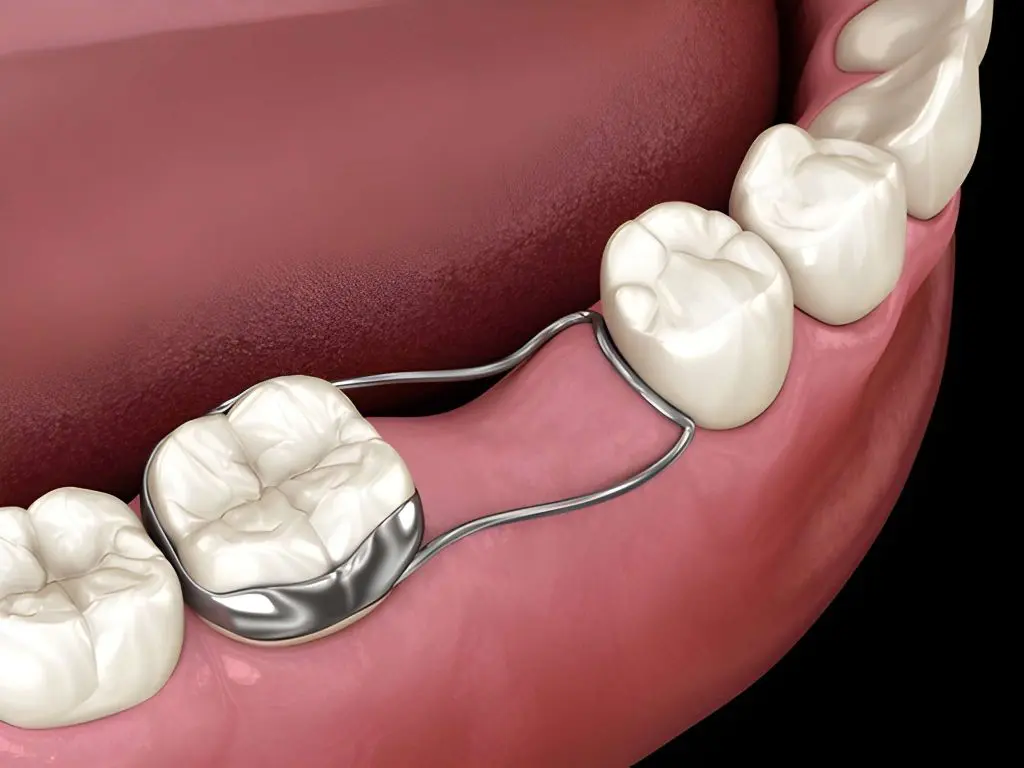
Space Maintainers for Kids in Guelph
Sometimes a baby tooth is lost too early, from decay, an extraction or an accident. When that happens, the teeth beside it can slowly drift into the gap and block the adult tooth underneath. A space maintainer is a small custom appliance that holds that space open until the adult tooth is ready.
- Baby teeth hold space for the adult teeth growing underneath.
- If one is lost early, nearby teeth can start shifting within months.
- A space maintainer keeps the gap open. Most are a small band and wire around a neighbouring tooth.
- Not every early tooth loss needs one. An x-ray shows us.
- Fitting usually takes two short visits with no needles or drilling. It’s removed once the adult tooth starts coming in.
What is a space maintainer?
A space maintainer is a small appliance, usually stainless steel, that’s custom-made for your child’s mouth. It holds open the gap left by a baby tooth that came out before its time, so the adult tooth has a clear path when it’s ready to erupt.
Most are fixed, meaning they’re cemented to a neighbouring tooth so your child can’t take them out. Some are removable, similar to a retainer. Children usually wear them anywhere from a few months to a few years, until the adult tooth begins to come through.
Why early baby tooth loss matters
Baby teeth do more than help with chewing and speech. They act as placeholders that guide the adult teeth into position. When a baby tooth is lost early:
- The teeth on either side can tip or drift into the gap. In the back of the mouth, this often starts within the first several months.
- The adult tooth can be left without enough room, so it comes in crooked or gets blocked (impacted).
- The bite can become uneven, and later orthodontic treatment may be longer or more complex.
Baby teeth are most often lost early because of tooth decay that needed an extraction. Injuries, infection and some developmental conditions are other causes.
Does your child need a space maintainer?
Not always. We look at several things before recommending one:
- Which tooth was lost. Back baby teeth (molars) are the most likely to need a maintainer. Front baby teeth usually don’t lose much space.
- Your child’s age and stage. Most children who need one are between about 4 and 12 years old.
- How close the adult tooth is. If x-rays show the adult tooth is about to come through, we may simply monitor instead.
- Whether space has already been lost. If neighbouring teeth have already shifted, we may involve an orthodontist.
- Your child’s oral hygiene and cavity risk. A fixed appliance needs good brushing around it to avoid new cavities.
If your child has just had a baby tooth removed or lost one in an accident, book a check soon rather than waiting for the next routine visit.
Types of space maintainers
| Type | What it looks like | Typically used when |
|---|---|---|
| Band and loop | A metal band around one tooth with a wire loop reaching across the gap | One back baby tooth is missing on one side. This is the most common type. |
| Crown and loop | Like a band and loop, but attached to a stainless steel crown | The anchor tooth also needs a crown because of decay |
| Lower lingual holding arch | A wire running along the inside of the lower teeth, attached to bands on both sides | Back teeth are missing on both sides of the lower jaw |
| Upper arch (Nance or transpalatal) | A wire across the roof of the mouth, sometimes with a small acrylic pad | Back teeth are missing on both sides of the upper jaw |
| Distal shoe | A band with an extension that guides the first adult molar as it erupts | A second baby molar is lost before the first adult molar has come in. Often planned with a specialist. |
| Removable | An acrylic plate, similar to a retainer, sometimes with a false tooth | Older, reliable children, or when a front tooth also needs replacing for appearance or speech |
Sometimes the best choice is no appliance at all, with careful monitoring at check-ups. We’ll tell you if that’s the case.
Fixed vs. removable: which is better?
Fixed
- Cemented in place, so it can’t be lost or forgotten
- Usually the first choice for younger children
- Back-tooth designs rarely affect speech
- Needs careful brushing around the band and wire
Removable
- Can be taken out for eating and cleaning
- Can include a false tooth to fill a visible gap
- Only works if it’s actually worn as directed
- Better suited to older, responsible children
Getting a space maintainer, step by step
- Exam and x-rays. We check which tooth was lost, how developed the adult tooth is, and whether any space has already been lost. If a maintainer is needed, we explain the options, timing and cost.
- Impression or scan. We take a quick mould or digital scan. For banded designs, we may first test-fit a small metal band on the anchor tooth. There’s no drilling.
- Custom fabrication. A dental lab makes the appliance to fit your child’s mouth. This usually takes 1-2 weeks.
- Fitting. At a short second visit, we check the fit and cement a fixed maintainer in place. For a removable one, we show you and your child how to put it in and take it out. Freezing usually isn’t needed.
- Check-ups. We look at the appliance at each recall visit and take x-rays as needed.
- Removal. When the adult tooth starts to come through, we remove the appliance in a quick, painless visit.
Sometimes a space maintainer can be fitted soon after the baby tooth is removed. Occasionally a band can be placed at the same visit as the extraction.
The first few days
- Your child may feel some pressure or mild soreness for a day or two. Soft foods help, as does over-the-counter children’s pain relief given as directed on the label.
- Their tongue will explore the wire. That usually stops feeling strange within a few days.
- Speech may sound slightly different with removable or tongue-side designs. This usually settles within a week.
- Most children are eating normally within a few days.
Caring for a space maintainer at home
Do:
- Brush twice a day with fluoride toothpaste, paying attention to the band and wire
- Floss daily. A floss threader helps around fixed appliances
- Rinse with water after meals and snacks
- Clean a removable appliance daily and keep it in its case when it’s out
- Keep every recall visit so we can check the fit and the adult tooth
Avoid:
- Sticky foods such as gum, toffee, caramel and gummies
- Biting into very hard foods. Cut apples, carrots and crusty bread into small pieces
- Pushing or pulling on the wire with fingers or tongue
- Wrapping a removable appliance in a napkin, which is how most get thrown out
If something goes wrong
Call us within a few days if:
- The appliance feels loose, bent or broken
- It comes out completely. Keep it and bring it with you
- A wire is poking the cheek or gum. Cover it with orthodontic wax or sugar-free gum in the meantime
- The gum around the band looks red, swollen or bleeds easily
- You can see the adult tooth starting to come in near the appliance
A loose maintainer can trap food and stops holding the space, so it shouldn’t wait until the next routine check-up.
Cost and insurance coverage
- Private insurance: Many plans cover space maintainers, but some list them under orthodontics, which may have separate limits. We can send a pre-treatment estimate to your insurer and bill them directly where your plan allows.
- Canadian Dental Care Plan: Space maintainers aren’t listed in the CDCP benefit grids we’ve reviewed. The CDCP does cover the exam, x-rays and extractions that often come first. We’ll confirm current coverage for your child before treatment.
A space maintainer usually costs much less than the orthodontic treatment that can follow if space is lost.
Space maintainers at Scottsdale Dental Centre
We see children from age 1 at our office on Scottsdale Drive in Guelph’s. We place most space maintainers here and check them at your child’s regular visits.
When a case needs more complex planning, such as a distal shoe or space that has already been lost, we refer to an orthodontist or paediatric dentist in the area. We stay involved in your child’s care throughout.
Space maintainer FAQs
Does every child who loses a baby tooth early need a space maintainer?
No. It depends on which tooth was lost, your child’s age, and how close the adult tooth is to coming in. Back baby molars are most likely to need one. Front baby teeth, and teeth whose adult replacement is about to erupt, often don’t. An x-ray tells us.
Does getting a space maintainer hurt?
No drilling or freezing is usually needed. Children may feel some pressure while it’s fitted and mild soreness for a day or two afterwards.
How long does a child wear a space maintainer?
Until the adult tooth starts to come through, which can be anywhere from a few months to a few years. We check it at each recall visit and remove it at the right time in a short, simple appointment.
Can my child eat normally?
Yes, after the first few days. Avoid sticky candy and gum, and cut hard foods into small pieces. Removable appliances are usually taken out for meals unless we say otherwise.
What should I do if the space maintainer comes loose or falls out?
Call us within a few days, and keep the appliance to bring in. A loose appliance can trap food, and one that’s out stops holding the space, so it should be re-cemented or replaced soon.
Will a space maintainer mean my child won’t need braces?
Not necessarily. It prevents crowding caused by teeth drifting into the gap, but jaw size and genetics also affect alignment. It can make any future orthodontic treatment simpler.
Is a space maintainer the same as a retainer?
No. A space maintainer holds a gap open for an adult tooth that hasn’t come in yet. A retainer keeps teeth in place after braces. Removable space maintainers can look similar to retainers, which is where the confusion comes from.
What happens if we decide not to get one?
Some children are fine, especially if the adult tooth is close. Others lose space, and the adult tooth comes in crowded or blocked, which may need orthodontic treatment later. We’ll explain your child’s specific risk so you can decide.
Did your child lose a baby tooth early?
Book a check and we’ll tell you whether a space maintainer is needed, which type, and what it will cost, or whether monitoring is enough.