
Botox for Jaw Pain and Headaches
When most people hear “Botox,” they think of cosmetic treatments. But dentists across Canada are increasingly using it to help patients with chronic jaw pain, teeth grinding, and other conditions that can be surprisingly hard to treat.
At Scottsdale Dental Centre in Guelph, Dr. Ahmad offers Botox as part of a comprehensive approach to oral health.
Why a Dentist for Botox?
Dentists are uniquely qualified to administer therapeutic Botox for jaw-related conditions. We spend our careers studying the relationship between jaw joints, bite alignment, and facial muscles, which means we can not only deliver the injections precisely, but also diagnose what’s actually driving your symptoms in the first place. A dentist administering Botox for TMJ isn’t just treating the pain; they’re treating the cause.
How It Works: More Than a Cosmetic Treatment
Most people associate Botox with wrinkle reduction, but in dentistry, it serves a very different purpose. Botox is a purified protein that temporarily relaxes overactive muscles. When injected into the jaw or surrounding areas by a trained dentist, it reduces the muscle tension responsible for pain and grinding.
What makes it particularly effective for dental conditions is a second mechanism: Botox also has direct pain-relieving properties. It acts on sensory nerve endings near the injection site, reducing discomfort at the source, not just masking it. This dual action makes it useful for conditions involving both muscle overactivity and chronic pain.
Treatments are quick, performed in-office, and require no recovery time. Most patients find the injections very tolerable.
Step 1 — Consultation & Assessment: Dr. Ahmad conducts a thorough evaluation that includes a bite assessment, jaw mobility testing, and bruxism analysis to confirm Botox is the right fit for your situation.
Step 2 — Targeted Injections: Small, precise injections are placed into the affected muscles, typically the masseter, temporalis, and surrounding areas. The appointment takes 10–15 minutes.
Step 3 — Gradual Improvement: You may notice mild tenderness for the first 24 hours. Results build over the following weeks, peaking around weeks 5–8.
Step 4 — Maintained Relief: Effects last 3–6 months. Repeat treatments maintain the benefit long-term. All changes to muscle tissue are fully reversible.
Conditions Treated
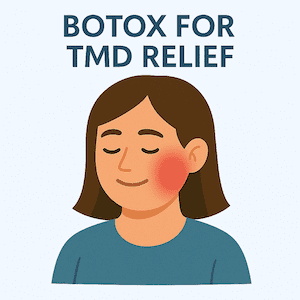
Jaw Pain (TMD): Temporomandibular disorder causes chronic jaw soreness, clicking, and tension. Studies show meaningful pain reduction lasting up to 6 months after treatment, making Botox a strong option when splints or other approaches haven’t fully worked.
Teeth Grinding (Bruxism): Grinding and clenching put enormous strain on your teeth, often causing worn enamel, cracked teeth, and morning headaches. Botox reduces the force behind these habits without affecting your ability to chew or speak normally.
Headaches: By relaxing tightened muscles in the face, jaw, and neck, Botox can significantly reduce both the frequency and intensity of secondary headaches, particularly those linked to jaw tension or grinding. Many patients are surprised by this benefit.
Lockjaw & Jaw Muscle Hypertrophy: Overactive masseter muscles can cause the jaw to feel locked or visibly enlarged over time. Botox relaxes these muscles, improving mobility and, as a secondary benefit, often creating a slimmer jawline appearance.
What to Expect
10–15 minute appointment: The injections themselves are quick. Most of your appointment time is spent discussing your symptoms and treatment plan.
Fine-needle injections, no freezing needed: Most patients describe it as a minor pinch. Dental freezing is not required for the procedure.
Return to normal activities immediately: There is no downtime. You may notice mild tenderness at the injection sites for the first 24 hours — this is normal and passes quickly.
Repeat every 3–6 months: Most patients return for repeat treatment in this window to maintain their results. Some find they need treatment less frequently over time.
Your Results Timeline:
Days 1–2: Mild tenderness at injection sites is normal and fades quickly. Weeks 1–4: Gradual reduction in muscle tension and discomfort. Weeks 5–8: Effects peak, most patients notice the greatest improvement during this window. Months 3–6: Effects gradually wear off; most patients return for a repeat treatment. Long-term: All changes to muscle tissue are fully reversible, no permanent effects observed in clinical studies.
Aftercare & Ongoing Management
Following treatment, your dentist will guide you through jaw relaxation exercises to support your recovery and extend your results. Depending on your situation, we may also recommend pairing Botox with a custom nightguard, bite adjustments, or stress-reduction strategies for the best long-term outcome. Botox works best as part of a broader plan, not in isolation.
Safety & Suitability
When administered by a trained dental professional, Botox is safe and well-tolerated. Clinical trials consistently show that side effects are mild and temporary.
Common side effects (mild & temporary): Slight reduction in biting force, minor facial asymmetry near the injection site, mild tenderness for the first 24 hours, and localized muscle weakness near injection sites.
Confirmed in clinical trials: No serious adverse events reported in major studies, no masticatory dysfunction observed, all muscle changes fully reversible over time, and no significant difference vs. placebo in adverse events.
Who should not receive Botox: Women who are pregnant, and individuals with certain neuromuscular disorders. Your dentist will review your full health history during your consultation to confirm you’re a suitable candidate before any treatment is recommended.
When Botox may not be the right fit: Botox is most effective for muscle-driven jaw pain and grinding. If your TMJ issues are caused by internal joint problems or arthritis, further dental evaluation will be needed and a different treatment approach may be more appropriate. We’ll always be upfront with you about this.
Our approach: Conservative treatments are always explored first. We only recommend Botox when it genuinely makes sense for your situation.
Insurance & Cost
Therapeutic Botox for conditions like TMD and bruxism is not typically covered by standard dental insurance plans in Ontario, though some plans may offer partial coverage when treatment is for medical rather than cosmetic purposes. We recommend calling your provider to ask specifically about coverage for therapeutic Botox. Our team is happy to provide the documentation needed to support any claim you choose to submit. We’ll walk you through costs clearly before any treatment begin, no surprises.
Schedule Your Botox for TMJ Consultation Today or Call us now at 519-836-5110 to book an appointment!