Does My Child Really Need to Be Put to Sleep for Dental Work?
Nitrous oxide vs. general anaesthesia for kids: what Guelph parents should know
A parent sat in our office on Scottsdale Drive recently, phone in hand, showing me a treatment plan from another clinic. Her four year old needed three fillings, and the plan called for general anaesthesia. She’d already Googled it, already lost sleep over it, and already started worrying about a wait list.
Her son had never once had a chance to try a regular appointment.
That happens more than it should. Somewhere along the way, “my child is nervous about the dentist” became “my child needs to be put to sleep,” and those are genuinely different situations. Most children who are anxious, wiggly, or simply young do not need general anaesthesia. Many of them do beautifully with nitrous oxide, better known as laughing gas, and a dental team that isn’t in a hurry.
We offer nitrous oxide, moderate sedation, and faciliate general anaesthesia treatments at Scottsdale Dental Centre, so we are not steering you toward the one thing we happen to offer. Dr. Ahmad’s training included a hospital-based General Practice Residency at Hartford Hospital, with rotations through their Anaesthesia, Emergency Medicine, and Internal Medicine departments. He has seen general anaesthesia from inside the hospital, not just from the dental chair. That’s exactly why he is careful about when to recommend it.
Some children genuinely need it. When that’s the case, we’ll say so plainly. But it should be the answer to a specific clinical question, not the default setting.
The short version
| Nitrous oxide (laughing gas) | General anaesthesia (sleep dentistry) | |
|---|---|---|
| What it is | Minimal sedation that takes the edge off | Full unconsciousness |
| Is my child awake? | Yes. Awake, talking, responsive | No. Completely asleep |
| Where it happens | Our Guelph office, in the regular chair | Hospital or accredited surgical facility |
| Who administers it | Your dentist and trained team | An anaesthesiologist or dental anaesthetist |
| How it’s given | Small nosepiece, no needle | IV and/or mask, airway managed |
| Time to kick in | About 3 to 5 minutes | Minutes, but after a full pre-op process |
| Recovery | Roughly 5 minutes of pure oxygen, then done | Hours in recovery, groggy the rest of the day |
| Rest of the day | School, soccer, dinner, all normal | Home, rest, no school |
| Eating beforehand | Light meal is fine, and usually encouraged | Strict fasting required |
| Typical wait to book | Days to weeks | Often months |
| Relative cost | Modest | Substantially higher |
What nitrous oxide actually is
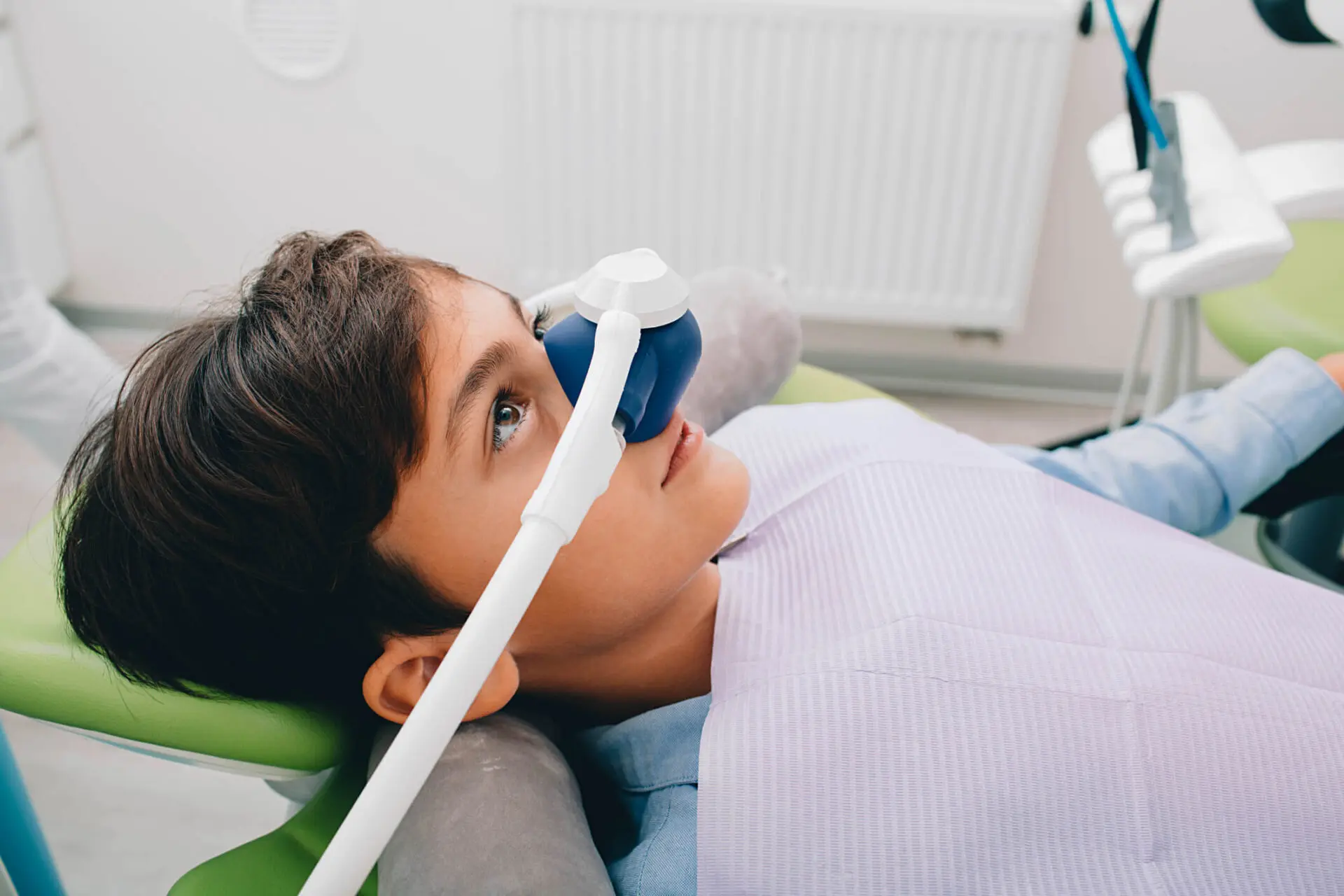
Nitrous oxide is a gas mixed with oxygen and breathed in through a small nosepiece that sits over your child’s nose. Think of a little pair of scuba goggles for the nose. Kids get to pick a scent.
The thing most parents don’t realize: your child stays awake. They can hear you, watch TV, answer questions, wiggle their toes, and tell us if something bothers them. Their protective reflexes for coughing, swallowing, and gagging all keep working normally. Nitrous doesn’t switch a child off. It turns the volume down on anxiety and makes time pass more comfortably.
It’s also unusually easy to reverse. We turn it off, give a few minutes of pure oxygen, and it clears out through the lungs. No lingering grogginess for most kids. Your child can eat lunch, go back to their afternoon, and make it to their evening activity.
Where nitrous falls short: it needs a child who can breathe through their nose and sit reasonably still. A stuffy nose from a cold means it won’t work well that day. A toddler who’s inconsolable, a child with certain respiratory conditions, or a case with a very long list of work may need something else. And because it only takes the edge off rather than eliminating awareness, a genuinely terrified child may still struggle.
What general anaesthesia actually is
A different category altogether. Your child is fully unconscious, their breathing is supported and monitored, and an anaesthesia provider manages them throughout. It happens in a hospital or accredited surgical facility, never as a casual add-on in a regular dental operatory.
It requires a pre-operative medical assessment, strict fasting, a driver, a recovery period, and a day cleared from your calendar.
That’s not a reason to be afraid of it. It’s a reason to be sure it’s necessary.
Why most kids don’t need to go to sleep
There’s a well-established ladder in children’s dentistry, and general anaesthesia sits at the top of it, not the middle:
- Behaviour guidance. Tell-show-do, where we show your child the instrument on their fingernail before it goes near a tooth. Counting out loud so they know when it ends. Letting them hold a mirror. Short appointments. A “stop” signal they control. This is a real clinical skill, and it works far more often than parents expect.
- A get-to-know-you visit first. Sometimes the whole fix is that the first appointment is nothing but a ride in the chair, a tooth count, and a sticker.
- Nitrous oxide. For the anxious, the wiggly, the gag-prone, and the child who needs a little help getting through a filling.
- Moderate sedation, in selected cases.
- General anaesthesia, when the options above genuinely won’t get the job done.
Scottsdale Dental Centre has been treating Guelph families since 1987, and in our experience most children who arrive labelled “won’t sit still” turn out to be children who were rushed, or seen somewhere without the time or setup for kids. Give them a slower first visit and a nosepiece with some cartoons to watch, and the picture usually changes.
When general anaesthesia genuinely is the right call
We would be doing you a disservice if we pretended nitrous solves everything. It doesn’t. General anaesthesia is the right, kind choice when:
- A very young child has extensive decay. A two or three year old needing eight or ten teeth restored will not get through that awake, and shouldn’t have to try across six appointments.
- There’s a medical or developmental reason cooperation isn’t realistic. Some children with autism, cerebral palsy, significant anxiety disorders, or complex medical needs are far better served by one controlled visit.
- A child has already had a frightening dental experience and can’t be brought back to a place of trust.
- There’s acute infection or pain that can’t wait for a gradual desensitizing process.
- Nitrous has been tried and didn’t work.
For these children, general anaesthesia isn’t the scary option. It’s the humane one. Trying and failing three times in a row does its own damage.
Is it safe?
Nitrous oxide is one of the gentlest tools in dentistry. Its most common side effect is mild nausea, which usually settles within minutes of stopping the gas.
General anaesthesia carries more risk than nitrous, which is simply what comes with unconsciousness and a managed airway. But for a healthy child having a single, short procedure with a qualified anaesthesia provider, it is considered safe. The sensible way to think about it is this: the safest option is the one your child actually needs. Choosing general anaesthesia when nitrous would have worked adds risk for no benefit. Avoiding it when your child needs it means untreated infection, pain, and usually more damage later.
If you have specific concerns about anaesthesia and your child, bring them to the consultation. It’s a fair question and it deserves a real conversation, not a paragraph on a website.
Cost and waiting
Cost. Nitrous oxide is billed in short time units and typically adds a modest amount to a regular appointment. General anaesthesia involves an anaesthesia provider, facility fees, and a much longer appointment, so the difference is usually an order of magnitude. We provide written treatment plans with pricing before anything starts, and we direct-bill insurance. Call (519) 836-5110 for current fees.
Waiting. Anaesthesia provider time for children’s dental surgery is limited. A child who could be treated with nitrous next week may instead spend longer waiting for a slot, in pain, with the decay progressing.
This is the part parents rarely hear when sleep dentistry gets suggested casually. It isn’t just a bigger procedure. It’s a bigger delay.
What a nitrous appointment looks like here
- Before: a light meal a couple of hours ahead. Not a big one, and not an empty stomach. Bring a comfort object if your child has one. Keep your language neutral, because “it won’t hurt” plants the word hurt. “Dr. Ahmad is going to count your teeth” works better.
- Arriving: your child picks a scent for the nosepiece. We show them everything before it’s used.
- During: the nosepiece goes on and we chat while it takes effect. Most kids describe it as tingly, floaty, or “like my legs are heavy.” They stay awake and talking the whole time.
- After: about five minutes of pure oxygen, then a few minutes sitting up. Most children are entirely themselves by the time they reach the parking lot.
- The rest of the day: normal.
The question to ask before you agree to sleep dentistry
If someone has recommended general anaesthesia for your child, it’s completely reasonable to ask:
“What would we have to try before this becomes necessary, and has my child had a fair chance at it?”
A good answer sounds like: “We tried a get-acquainted visit and nitrous, and here’s specifically what happened.” Or: “There are eleven teeth involved and she’s three, so awake treatment isn’t realistic.”
If the answer is just “kids that age don’t cooperate,” a second opinion is worth your time.
Book a consultation in Guelph
Book an appointment online or call us today at (519) 836-5110!
We see families from across Guelph and the surrounding communities of Fergus, Elora, Rockwood, Puslinch, and Aberfoyle.
If you’ve been told your child needs to be put to sleep and you’d like a second opinion, we’re glad to give you an honest one, including telling you when general anaesthesia really is the better path.