Air Polishing Dental Cleaning in Guelph
A Gentler, More Thorough Clean
If you’ve ever left a dental cleaning feeling like the experience was more uncomfortable than it needed to be, or if sensitivity, anxiety, or the sensation of scraping metal instruments has caused you to put off booking your next hygiene appointment, we have good news.
Dental hygiene technology has changed significantly in recent years, and at Scottsdale Dental Centre in Guelph, our hygiene team now offers advanced air polishing as part of our cleaning appointments. This approach is gentler, more thorough, and for most patients, noticeably more comfortable than a traditional cleaning.
Here is everything you need to know.
What is air polishing?
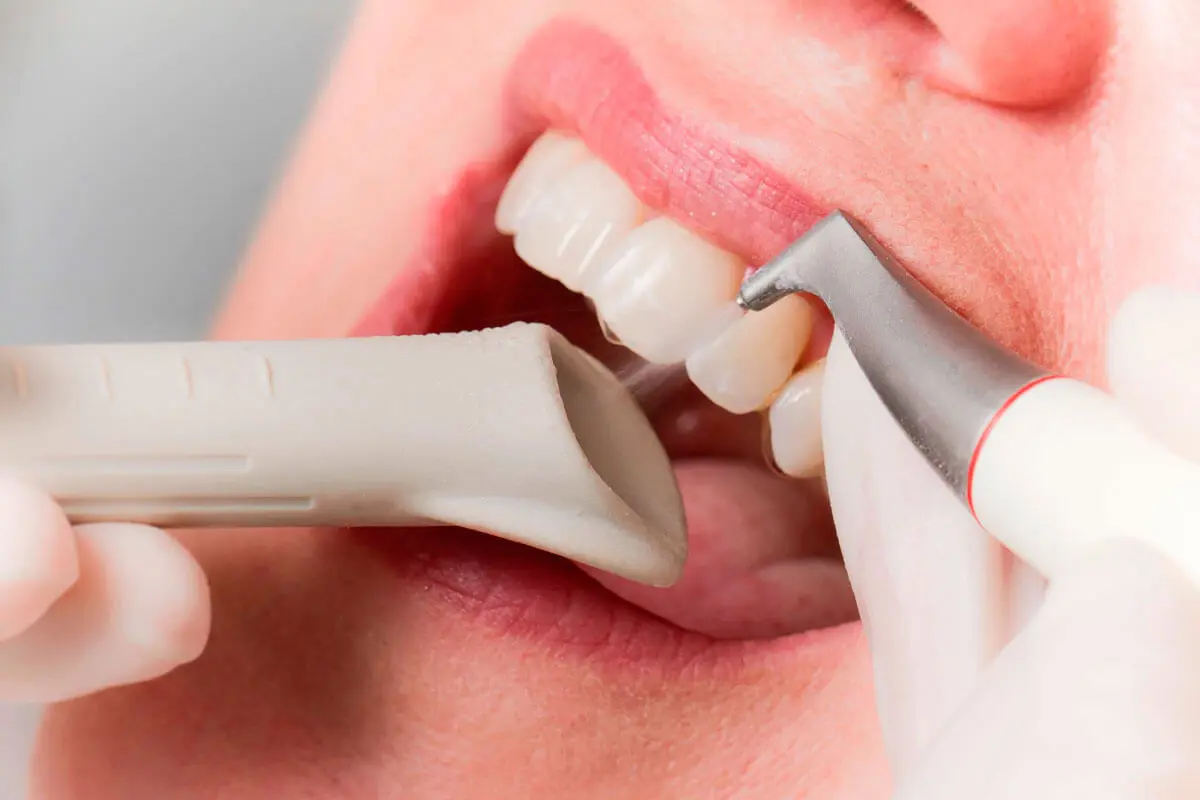
Air polishing, sometimes called air prophy, is a professional cleaning technique that uses a controlled stream of air, water, and a specially formulated fine powder to remove biofilm, plaque, surface staining, and soft deposits from the surfaces of your teeth, between your teeth, along the gumline, and in many cases just below it.
The powder we use is erythritol or glycine or carbonate based, with an ultra-fine particle size of just 14 microns, significantly finer than the abrasive paste used in conventional rubber cup polishing, which typically ranges from 40 to 65 microns. This makes air polishing not just more comfortable but genuinely less abrasive to your tooth surfaces, restorations, and surrounding gum tissue.
How is it different from a traditional cleaning?
Most patients are familiar with the standard dental cleaning experience, metal scalers to chip away hardened tartar, a rubber polishing cup spinning with gritty prophy paste to buff off staining, and the occasional discomfort or sensitivity that can accompany both.
Traditional techniques are effective and remain part of our protocols where clinically appropriate. But they have real limitations worth understanding.
Conventional prophy paste works through physical abrasion, grinding staining and soft deposits off tooth surfaces. Over time and with repeated use, this can cause measurable enamel loss, and it can be uncomfortable, particularly for patients with exposed root surfaces, existing sensitivity, implants, or cosmetic restorations like veneers or crowns.
Metal scalers, while essential for removing hardened calculus, cannot access the spaces between teeth, the deeper grooves and fissures, or the areas just below the gumline where biofilm accumulates and gum disease begins.
Advanced air polishing addresses all of these limitations simultaneously. The air and water stream reaches into spaces that a rubber cup simply cannot access. The ultra-fine erythritol or glycine or carbonate based powder is gentle enough to be used safely on enamel, dentine, soft tissue, implant surfaces, composite restorations, veneers, and orthodontic appliances. And because the system works by disrupting and flushing away biofilm rather than mechanically grinding it off, the overall experience is significantly more comfortable for the vast majority of patients.
Many patients also find that appointments feel faster, the high-efficiency stream covers surfaces quickly and can reduce the total time spent in the chair compared to a conventional cleaning of equivalent thoroughness.
What is biofilm, and why does removing it matter?
Biofilm is the thin, organized layer of bacteria that forms continuously on the surfaces of your teeth, gums, implants, and any dental restorations. It is the sticky film you feel on your teeth when you wake up in the morning, and it is the primary cause of both tooth decay and gum disease.
Brushing and flossing disrupts biofilm effectively in accessible areas. But certain place, the grooves and pits of back teeth, tight spaces between teeth, the sulcus just below the gumline, and the surfaces around implants and orthodontic brackets, are consistently difficult to clean thoroughly at home, even with excellent habits.
Professional biofilm removal at regular intervals is the cornerstone of long-term oral health. What makes air polishing with erythritol or glycine or carbonate based powder particularly effective is its ability to reach biofilm in areas that conventional rubber cup polishing simply cannot access, including spaces between teeth, along the gumline, and around implants and restorations.
Who benefits most from air polishing?
Air polishing is suitable for patients of all ages, including children, teenagers, adults, and elderly patients. In our clinical experience, the following groups benefit particularly:
Patients with dental anxiety or sensitivity. The gentler action of air polishing, the absence of aggressive scraping, and the quieter sound of the system combine to make the cleaning experience significantly less stressful for patients who typically find hygiene appointments uncomfortable or who have been putting off care for that reason.
Patients with heavy staining. Coffee, tea, red wine, and tobacco can cause persistent surface staining that a rubber cup struggles to remove efficiently. The air polishing stream lifts these stains quickly and gently, reaching into the nooks and contours where conventional polishing misses.
Patients with implants. Erythritol and glycine powder is safe to use directly on implant surfaces, where abrasive prophy paste can cause micro-damage over time. This makes air polishing the cleaning method of choice for patients with single implants, implant-supported bridges, or full-arch restorations.
Patients with cosmetic restorations. Veneers, ceramic crowns, and composite bonding can be micro-scratched by conventional polishing paste with repeated use. Air polishing is gentle on all of these surfaces while providing an effective and thorough clean.
Patients with braces or clear aligners. Orthodontic appliances create additional surfaces and spaces where biofilm accumulates and is difficult to reach. Air polishing cleans thoroughly around brackets, wires, and aligner attachment points where rubber cups cannot reach effectively.
Patients on periodontal maintenance. For patients who have been treated for gum disease and attend more frequent recall appointments, thorough biofilm removal is a priority at every visit. The reach and precision of air polishing makes it highly effective for ongoing periodontal maintenance care.
Patients returning to dental care after a gap. For patients coming back to dental care after some time away, air polishing can be a more approachable and comfortable cleaning experience, particularly for those who are nervous about what the appointment will feel like.
What does air polishing feel like?
Most patients describe the experience as noticeably different from what they expected — and considerably more pleasant.
Rather than the mechanical scrubbing of a rubber cup or the scraping of metal instruments, you will feel a gentle pressurized spray. The sound is softer and quieter than the conventional polishing handpiece. Because there is no direct contact between a rotating tool and your tooth surface, the vibration and pressure that can cause discomfort with traditional methods is largely absent.
You may notice a very mild sweet taste from the erythritol or glycine powder, this is temporary and fades quickly. There is no gritty aftertaste or residue, which many patients find one of the most immediately noticeable differences from a conventional cleaning.
After your appointment, your teeth will feel exceptionally smooth and clean. If you had surface staining from coffee, tea, or red wine, you will likely notice that your teeth look noticeably brighter.
After your air polishing appointment, a few things to know
Following an air polishing appointment, we recommend avoiding deeply staining foods and drinks, such as coffee, tea, red wine, and curry, for a few hours afterward. The clean surfaces of your teeth are temporarily more susceptible to restaining in the immediate post-cleaning window, and giving them a few hours before reintroducing heavy staining foods helps maintain your results for longer. If you smoke, the same recommendation applies.
Some patients notice mild gum tenderness after the appointment, particularly if there was some existing gum inflammation. This is normal and typically resolves quickly. A temporary sweet taste from the erythritol or glycine powder may also linger briefly, this is not cause for concern and fades on its own.
A note on what air polishing is and isn’t
Air polishing is one technique within a professional hygiene appointment, not a standalone replacement for a comprehensive cleaning. Hardened tartar (calculus) cannot be removed by air polishing alone and still requires ultrasonic or hand scaling instruments. Your hygienist will always use the combination of techniques most appropriate for your individual clinical needs at each visit.
What air polishing replaces , and replaces well, is the traditional rubber cup and prophy paste polishing step, which it does more gently, more thoroughly, and with access to areas that conventional polishing cannot reach.
Dental cleaning at Scottsdale Dental Centre in Guelph
At Scottsdale Dental Centre, our experienced hygiene team is trained in the full range of professional cleaning, including ultrasonic scaling, hand scaling, conventional polishing, and advanced air polishing, and selects the approach most appropriate for each patient’s individual needs at each appointment.
We invest in advanced technology because it produces better clinical outcomes and because our patients deserve a cleaning experience that is as comfortable as it is thorough.
We are currently welcoming new patients of all ages. We accept most major insurance plans, offer direct billing to your provider, accept the Canadian Dental Care Plan (CDCP), and offer flexible payment options. If you’d like to ask about air polishing or request it at your next appointment, simply mention it when you call or book online.
Call us today at (519) 836-5110 or click here here to book an appointment.