
Digital Dental Impressions in Guelph | No Trays, No Gagging, Better Results
If the thought of dental impressions makes you tense up, you are not alone. The plastic tray, the thick paste, the sensation that many patients describe as similar to having a big wad of gum stuffed into their mouth, the need to hold still for minutes while trying not to gag, for a significant number of people, this experience is one of the most dreaded parts of dental care.
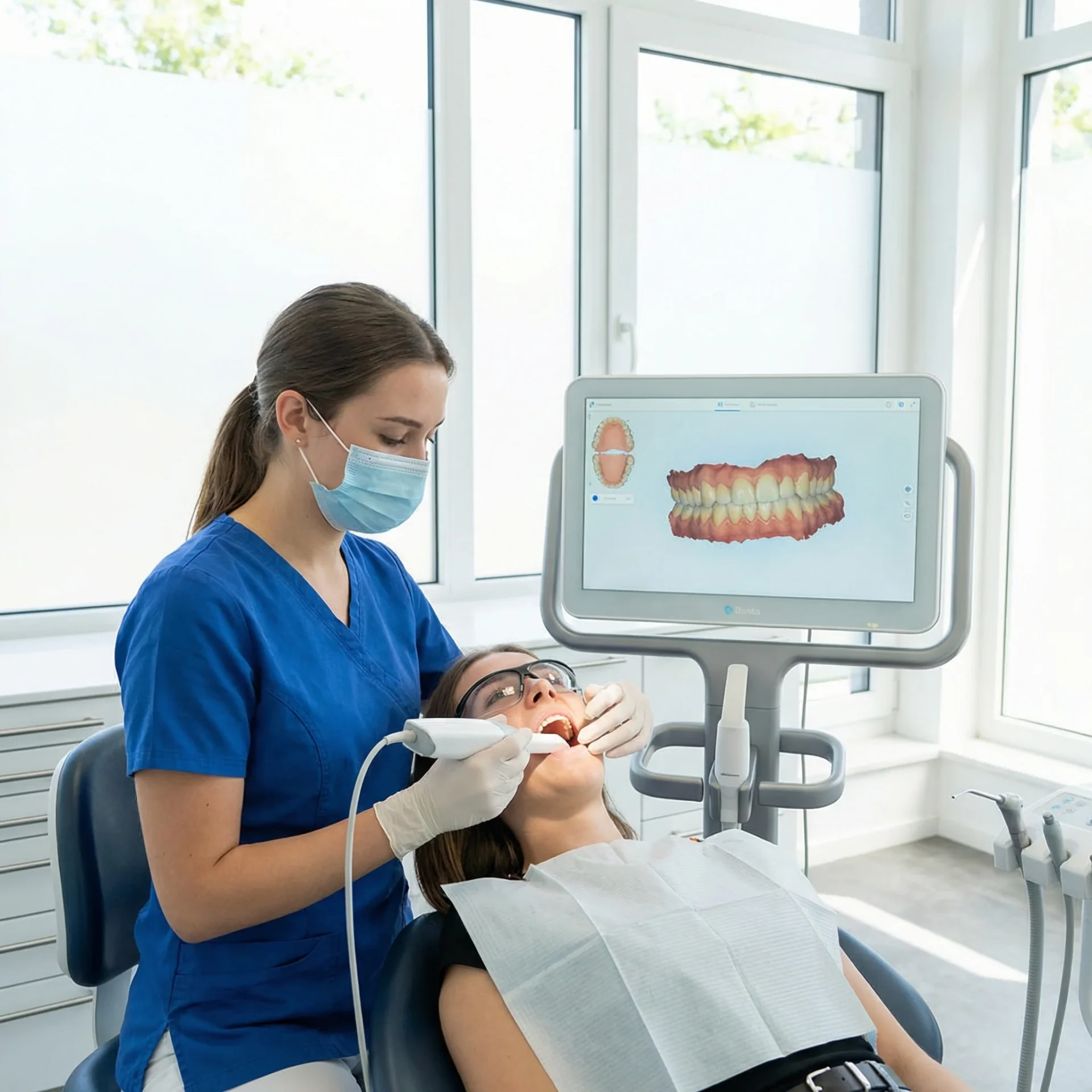
At Scottsdale Dental Centre in Guelph, we use advanced digital scanning technology to take impressions of your teeth without any of that. No trays. No paste. No gagging. Just a small, comfortable wand that moves gently through your mouth for a few minutes and produces a precise, detailed three-dimensional digital model of your teeth and gums.
For many of our patients, this is one of those small discoveries that changes how they feel about dental visits entirely.
Here is everything you need to know about how digital impressions work, how they compare to traditional methods, what they are used for, and why the difference matters.
What are digital dental impressions?
A dental impression is a record of the shape, size, and position of your teeth and surrounding tissues. For decades, the only way to take one was with physical impression materials, a tray loaded with a thick paste that was placed in your mouth and held there while it set. The resulting mold was then sent to a dental laboratory to be used as the basis for crowns, bridges, dentures, aligners, and other restorations.
Digital dental impressions replace this entire process with an intraoral scanner, a handheld device roughly the size of an electric toothbrush that uses a light source and a small camera to capture thousands of images per second of the surfaces inside your mouth. These images are instantly processed by sophisticated software into an accurate, detailed three-dimensional digital model of your teeth and gums that can be viewed on a screen in real time, shared digitally with dental laboratories, and used to design and fabricate restorations with exceptional precision.
The result is a process that is faster, more comfortable, more accurate, and more informative than traditional impression-taking, for both patients and clinicians.
Digital impressions vs traditional impressions, a direct comparison
Understanding the difference between digital and traditional impressions helps explain why so many dental practices and patients have embraced intraoral scanning so rapidly.
Traditional impressions require a tray sized to your mouth, loaded with a thick impression material, and held in position for up to several minutes while the material sets. The material has a distinctive taste and texture that many patients find deeply unpleasant. The gag reflex is frequently triggered. Movement during setting can distort the impression, requiring the process to be repeated, sometimes multiple times. Once set, the physical mold must be carefully removed, packaged, and shipped to a dental laboratory, where it is used to create a plaster model. Physical molds can shrink, warp, or be damaged in transit. If the laboratory identifies a problem with the impression quality, the patient must return for a repeat appointment. Traditional impressions have also been known to be rejected, broken, or misplaced during the laboratory process entirely.
Digital impressions require none of this. A small, slim scanning wand is moved gently through your mouth using the latest optical technology. There is no tray, no setting material, no unpleasant taste, and no requirement to hold still for an extended period. Crucially, the scanning process can be stopped and started as many times as necessary, meaning any moment of discomfort, a cough, or simply needing a break does not mean starting over. The three-dimensional model appears on a screen in real time as the scan progresses. When the scan is complete, the digital file is transmitted to the laboratory instantly. There is nothing to ship, nothing to wait for, and no risk of physical distortion.
The clinical accuracy of digital impressions is well established. Because the digital model does not shrink, distort, or shift between the appointment and the laboratory, restorations fabricated from digital impressions consistently fit more precisely, require fewer adjustments at fitting, and have a lower remake rate than those made from traditional impressions.
Why traditional impressions were such a problem for so many patients
To understand why digital impressions represent such a meaningful improvement, it helps to understand exactly what made traditional impressions so uncomfortable for so many people.
The materials involved are thick, dense, and taste strongly of the flavouring agents used to make them tolerable. They trigger a gagging reflex in a significant proportion of patients, not because the patient is doing anything wrong, but because placing a foreign substance in the back of the mouth is inherently challenging for people with a sensitive gag reflex. For some patients, this alone was enough to cause significant anxiety before dental appointments or to delay treatment they needed.
The trays themselves needed to be sized and seated correctly, which required multiple attempts for many patients. Once in place, the material took time to set, during which the patient needed to remain still, breathe through their nose, and manage any discomfort or anxiety. If anything moved or shifted during this process, the impression could be distorted and the whole process needed to be repeated.
The resulting physical mold then needed to be carefully packaged and sent to a dental laboratory, introducing delay and the possibility of damage or distortion in transit. For patients who were anxious, had a sensitive gag reflex, needed complex restorations, or simply found the experience deeply unpleasant, traditional impressions were one of the most reliably difficult parts of receiving dental care.
How digital impressions feel and what actually happens
At Scottsdale Dental Centre, taking a digital impression is a calm, comfortable, and often surprisingly quick process.
Your dentist or dental assistant will use a small handheld scanning wand, slender, smooth, and covered with a disposable hygienic sleeve for each patient, and move it slowly through different areas of your mouth. You will be asked to open comfortably and hold reasonably still, but there is no material being set, no tray pressing into your tissues, and nothing triggering your gag reflex at the back of your throat.
The entire scan is completely radiation-free. Unlike dental x-rays, intraoral scanning uses harmless visible light to capture images, making it safe for patients of all ages including children and pregnant patients.
As the scan proceeds, a three-dimensional model of your teeth builds in real time on a nearby screen. For many patients this is genuinely interesting. You can see your own teeth in vivid three-dimensional detail for the first time, from angles that would otherwise be impossible to view, and follow the progress of the scan as it happens. For patients with dental anxiety, being able to watch the process on screen and understand exactly what is happening is often genuinely reassuring.
One of the most practically important features of digital scanning is that the process can be stopped and started as many times as necessary without affecting the quality of the final result. If you need to swallow, cough, or simply pause for a moment, the scan can be paused and resumed immediately. This is a meaningful difference from traditional impressions, where any movement during the setting process could require starting over entirely.
A full-arch digital scan typically takes between two and five minutes. A single-tooth or quadrant scan for a crown takes less. When the scan is complete, the digital model is immediately available. There is nothing to package, nothing to wait for, and nothing to risk damage in transit.
What digital impressions are used for at our Guelph practice
Digital impressions are used across a wide range of treatments at Scottsdale Dental Centre. Here is where you are most likely to encounter them.
Crowns and bridges. When a tooth needs a crown to restore its strength, shape, and appearance, or when a bridge is needed to replace one or more missing teeth, an accurate impression of the prepared tooth and the surrounding teeth is essential. The laboratory fabricates the restoration to precise specifications based on this record, which means the accuracy of the impression directly determines the accuracy of the final crown or bridge. A crown that fits well from the first seating is better for the underlying tooth, kinder to the gum tissue, and more comfortable for the patient. Digital impressions achieve this level of fit more reliably than traditional methods, and the digital file reaches the laboratory the same day without risk of distortion in transit.
Invisalign and clear aligner orthodontics. Digital impressions are central to the Invisalign treatment process. A precise three-dimensional scan of your teeth is used to plan your entire treatment digitally, to show you a simulation of how your teeth are projected to move through treatment, and to fabricate every set of custom clear aligners in your sequence. The accuracy of the initial scan directly affects the precision of every aligner. At Scottsdale Dental Centre we use digital impressions for all Invisalign cases, which means your treatment planning is based on exact data rather than a physical mold that can shrink or distort before it reaches the aligner manufacturer.
Dental implants. Planning and restoring dental implants requires detailed three-dimensional information about the position and angulation of the implant, the surrounding bone, and the neighboring teeth. Digital impressions contribute to both the planning and the fabrication of implant-supported crowns and restorations. Because implant restorations must fit with particular precision at the implant connection, the accuracy advantage of digital impressions is especially significant in implant cases.
Veneers and cosmetic restorations. For cosmetic work where aesthetics and fit need to be exceptional, digital impressions provide a more detailed and accurate record than traditional materials. They also allow us to show you a digital preview of planned changes to your smile before any preparation of your teeth begins, which is particularly valuable for patients considering veneers or a full smile makeover.
Dentures and partial dentures. Digital impressions for dentures capture the shape of the gum tissue and any remaining teeth with a level of detail that supports more accurately fitting prostheses. For complete denture patients, comfort and function depend heavily on how precisely the denture fits the underlying tissue. For partial denture patients, the fit around remaining teeth is equally critical. Digital impressions support better outcomes in both cases.
Night guards and sports guards. Custom-fitted occlusal guards for teeth grinding and TMJ management, and custom sports guards for athletes, both require accurate impressions of your teeth. Digital impressions make this process faster and significantly more comfortable, particularly relevant for patients who need guards on an ongoing basis and would otherwise need to tolerate traditional impressions repeatedly.
Orthodontic records and monitoring. Digital scans create detailed baseline records of your teeth that can be compared over time, useful for tracking wear, shifting, spacing changes, or other developments that might otherwise be difficult to detect without side-by-side comparison of detailed records.
The accuracy advantage and why it matters for your treatment
One of the most clinically meaningful benefits of digital impressions is accuracy. Traditional impression materials are subject to distortion from the material itself shifting slightly as it sets, from the patient moving, from the tray not being perfectly seated, or from the physical mold distorting during removal, handling, or shipping. Even small amounts of distortion translate directly into restorations that do not fit as well as they should.
Digital intraoral scanners capture thousands of images per second and assemble them into a highly accurate three-dimensional model that does not shrink, distort, or shift between the appointment and the laboratory. The digital file that arrives at the laboratory is identical to the digital file that was created in the practice.
For complex restorations that require precise fit, particularly implant-supported crowns, multi-unit bridges, and full-arch restorations, this accuracy advantage translates directly into better-fitting results, fewer appointments for adjustments, and a lower likelihood of needing a remake. In clinical terms, a restoration that fits precisely from the first seating is not just more convenient. It is better for the long-term health of the tooth, the surrounding gum tissue, and the function of your bite.
Patients also benefit from the immediate visual feedback that digital scanning provides. Because your dentist can review the three-dimensional model on screen during the appointment, any areas that need to be rescanned can be identified and addressed before you leave the chair, rather than being discovered days later when a physical mold arrives at the laboratory.
Digital impressions and dental anxiety
We work with a significant number of patients who experience dental anxiety, ranging from mild nervousness to significant fear that has caused them to avoid care for years. For many anxious patients, the gag reflex, the claustrophobic feeling of a tray, and the loss of control during traditional impression-taking are among the most distressing parts of any dental appointment.
Digital impressions remove all of these triggers. There is no tray, no paste, no extended period of holding still with something filling your mouth. The process is calm, predictable, and visible. You can watch exactly what is happening on screen throughout. The ability to pause the scan at any moment means you are always in control of what is happening.
If dental anxiety is a factor for you, we encourage you to mention it when you book your appointment. We offer nitrous oxide and moderate oral sedation for patients who need additional support, and our entire team is experienced in working with anxious patients. Digital impressions are one of a number of ways we have invested in making dental care more accessible and less stressful for people who have found it difficult in the past.
Digital impressions for patients with a sensitive gag reflex
A sensitive gag reflex is one of the most common reasons patients dread traditional impressions and one of the most common things patients tell us they are relieved to avoid when they experience digital scanning for the first time.
The gag reflex is triggered by stimulation at the back of the mouth and throat. Traditional impression trays loaded with setting material are placed directly in the area most likely to trigger this response, and the patient must hold still for an extended period while the material sets. For patients with a sensitive gag reflex, this process can be genuinely distressing and occasionally impossible to complete successfully on the first or even second attempt.
Digital scanning with a small, slender wand that moves through the mouth without resting in position eliminates this trigger almost entirely. The scanner does not need to reach the back of the throat, does not require the patient to hold still with something in their mouth for an extended period, and can be paused at any moment if needed.
If a sensitive gag reflex has caused you problems with impressions in the past, or if you have been avoiding treatment because of it, please mention this when you call. We can assure you that for the vast majority of patients, digital impressions are an entirely comfortable experience.
Are digital impressions right for everyone?
Digital impressions are suitable for the vast majority of dental patients including children, adults, and elderly patients. There are a small number of clinical situations where traditional impressions may still be preferred or used alongside digital scanning, and your dentist will always recommend the approach most appropriate for your specific treatment needs.
For patients with certain types of deep gum pockets or complex surgical sites, a combination of digital and traditional techniques may be used to ensure the most accurate record possible. Your dentist will explain clearly what approach they are recommending and why before any impression is taken.
In the great majority of cases involving crowns, bridges, Invisalign, implants, veneers, dentures, and custom guards, digital impressions are not only suitable but represent the superior clinical option.
Frequently asked questions about digital dental impressions
Do digital impressions cost more than traditional impressions? At Scottsdale Dental Centre, digital impression technology is part of our standard care for the treatments where it is indicated. The investment we have made in this technology is one we consider part of providing genuinely excellent care, not an extra charge to patients. Most dental insurance plans cover impressions as part of the treatment they relate to regardless of whether they are digital or traditional. We direct bill most major insurance providers and accept the Canadian Dental Care Plan.
How long does a digital scan take? A full-arch digital scan typically takes between two and five minutes depending on the complexity of what needs to be recorded. A single-tooth or quadrant scan for a crown takes less time. The total time is almost always shorter than a traditional impression appointment, and there is no waiting for material to set.
Can I see my teeth on the screen during the scan? Yes. One of the things patients comment on most frequently is being able to watch the three-dimensional model build on screen in real time. It is both informative and genuinely interesting, and for many patients it helps them understand their dental health in a way that descriptions and flat photographs simply cannot replicate. It also improves communication during the consultation and treatment planning process because both you and your dentist can look at exactly the same detailed image together.
Are digital impressions safe? Yes. Digital intraoral scanning uses harmless visible light to capture images and does not involve any radiation whatsoever. It is completely safe for patients of all ages including children and pregnant patients.
What if the scan needs to be redone? If any area of the scan is unclear or incomplete, your dentist can rescan that specific area in seconds without any additional discomfort. And because the scanning process can be stopped and started as many times as necessary, there is no pressure to rush through the appointment. This is one of the significant practical advantages over traditional impressions, where a distorted or incomplete physical mold requires the entire impression to be retaken.
What happens to my digital scan after the appointment? Your digital scan file is stored securely in your patient record and transmitted electronically to the relevant dental laboratory or used directly within our practice for treatment planning. Because it is a digital file, it can be retrieved, referenced, and compared with future scans at any time, which is useful for monitoring your oral health over time.
What to expect at your appointment
If your treatment plan includes digital impressions at Scottsdale Dental Centre, here is what your appointment will look like.
Your clinician will explain what they are going to do before they start. The scanning wand will be shown to you and you will have the opportunity to ask any questions. You will be asked to open comfortably, not as wide as possible but comfortably, and the scan will begin.
You will be able to see the three-dimensional model building on the screen beside you as the scan progresses. If you have questions about what you are seeing, your clinician can explain in real time. If you need a break at any point, the scan can be paused immediately and resumed without any loss of quality.
When the scan is complete, the model is reviewed on screen to ensure completeness and accuracy. In most cases this happens within the appointment with no need to return. The digital file is then transmitted to the relevant laboratory or used directly within the practice for treatment planning.
There is no recovery time, no sensitivity from impression materials, and no aftertaste beyond what you would normally experience at a dental appointment.
Digital impressions at Scottsdale Dental Centre in Guelph
At Scottsdale Dental Centre, we have invested in digital impression technology because it produces better clinical outcomes and because our patients deserve a more comfortable experience. We believe that the physical discomfort of traditional impressions, for patients who experience it, is not an acceptable baseline when a better option exists.
We have been caring for Guelph families at 630 Scottsdale Drive since 1987, and we continue to invest in the technology and techniques that make that care genuinely excellent. Digital impressions are one part of a clinical environment that also includes cone beam CT scanning, 3D printing, digital x-rays, advanced air polishing, CAD-CAM restorations, and in-house surgical capability for implants, sedation, and wisdom teeth removal, all without referrals to outside specialists.
We are currently welcoming new patients of all ages. We accept most major insurance plans, offer direct billing to your insurance provider, and accept the Canadian Dental Care Plan. Same-day emergency appointments are always available.
Call us today at (519) 836-5110!