Is Your Child’s Snoring a Dental Problem? What Every Parent Should Know
As dentists, we often see your child more regularly than almost any other healthcare provider, sometimes twice a year from a very young age. That puts us in a unique position to notice things that might otherwise go undetected. One of those things is signs of sleep-disordered breathing. You might be surprised to hear that snoring and sleep apnea are partly a dental and oral health issue. The shape of your child’s mouth, jaw, and airway, things we look at every single visit, play a central role in whether your child breathes well at night. And when they don’t, the effects can reach far beyond just being tired.
What Is Sleep-Disordered Breathing?
- An umbrella term covering a range of conditions, from simple habitual snoring to obstructive sleep apnea (OSA), where breathing actually pauses during sleep
- Affects roughly 1 in 10 children
- Enlarged tonsils and adenoids are the most common cause
- The size and shape of the jaw, palate, and airway also play a major role, and that is where dentistry comes in
What We See in the Dental Chair
During a routine exam, we may notice signs that your child’s airway may be struggling at night. These include:
- A high, narrow palate (the roof of the mouth), which leaves less room for the tongue and can crowd the airway
- A posterior crossbite, where the upper back teeth bite inside the lower teeth, often a sign of a constricted upper jaw
- A small or recessed jaw, which can cause the tongue to fall back and block the airway during sleep
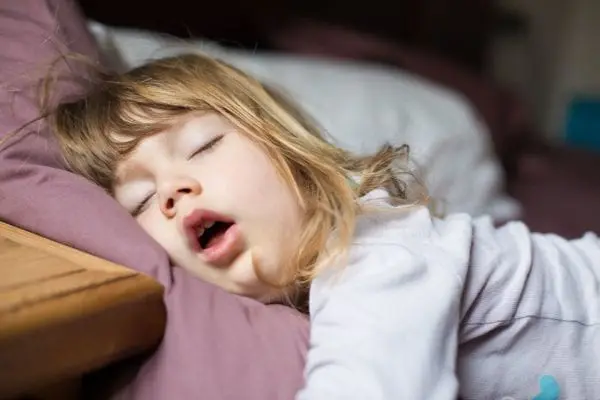
- Lips apart at rest, indicating habitual mouth breathing
- Adenoidal facies, a characteristic facial appearance associated with chronic mouth breathing, including a long narrow face, flattened cheekbones, and a gummy smile
- Scalloping on the sides of the tongue, caused by the tongue pressing against the teeth when it has nowhere to rest properly
- Dental crowding, which often signals a narrow arch that may not leave enough room for the airway either
- Worn tooth surfaces from nighttime grinding and clenching (bruxism)
Nighttime teeth grinding and clenching deserves special mention. Many parents notice the sounds their child makes during sleep, or we identify worn tooth surfaces at a checkup. Research suggests a meaningful link between bruxism and sleep-disordered breathing in children. When the airway becomes partially blocked during sleep, the brain can trigger jaw movements as a reflex to reopen it. If we tell you your child is grinding their teeth at night, it may be worth exploring whether their airway and sleep quality are also being affected.
Nighttime Signs to Watch for at Home
- Loud or noisy snoring occurring three or more nights per week
- Pauses in breathing, gasping, or choking sounds during sleep
- Heavy sweating during sleep
- Restless sleep, frequent tossing and turning
- Unusual sleep positions such as sleeping on hands and knees or with the neck stretched back
- Mouth breathing during sleep
- Audible nighttime teeth grinding or clenching
- Resuming bedwetting after previously being dry at night, an important and often overlooked warning sign
Daytime Signs to Watch for at Home
- Trouble concentrating or seeming forgetful
- Behavioral or mood problems, emotional outbursts
- Waking up with headaches
- Hyperactivity or impulsivity
- Falling behind at school or struggling to learn
- Mouth breathing during the day
- Difficulty swallowing or unclear speech
- Slower growth than expected
It is worth knowing that children under 5 tend to show more nighttime symptoms, while children over 5 more commonly show daytime symptoms like behavioral problems and difficulty paying attention.
Could Snoring Be Affecting Your Child’s Learning?
This is a question many parents and even many healthcare providers don’t think to ask, and the research has a sobering answer. A 2024 study published in JAMA Otolaryngology Head and Neck Surgery followed nearly 500 children ages 3 to 12 who snored regularly. These were children with mild sleep-disordered breathing, not severe sleep apnea. The findings included:
- Nearly 1 in 4 children with mild snoring had measurable problems with executive function, including self-control, emotional regulation, focus, and working memory
- Children most affected were those whose sleep problems had the biggest impact on daily quality of life, including disrupted sleep, emotional difficulties, and caregiver stress
- Emotional symptoms like moodiness and irritability had the strongest link to cognitive difficulties of all the symptoms studied
- The standard sleep study number (the apnea-hypopnea index) was not linked to these cognitive difficulties in mild cases, meaning a sleep study that looks relatively normal does not mean your child is unaffected
- Even mild, frequent snoring can affect learning, attention, and behavior
The Evidence-Based Treatment Landscape
Before discussing what dentistry specifically offers, it helps to understand how sleep-disordered breathing is treated overall. Guidelines from the American Academy of Pediatrics and the American Thoracic Society support a stepwise, often combined approach:
Tonsil and Adenoid Removal (Adenotonsillectomy):
- The recommended first-line treatment for most children with OSA and enlarged tonsils or adenoids
- Shown to improve behavior, quality of life, and sleep symptoms in the majority of children
- The landmark CHAT trial confirmed that early surgery is superior to watchful waiting in school-age children
- Up to 40% of children may still have some degree of sleep apnea after surgery, making follow-up essential
- Children with obesity, certain jaw structures, or other risk factors are more likely to have persistent OSA after surgery
Watchful Waiting:
- A reasonable first approach for children with mild OSA and small tonsils, particularly those under 5
- Research including the KATE trial suggests that children with mild signs of OSA and small tonsils may improve without immediate surgery
- Children with moderate to severe OSA, larger tonsils, or significantly affected quality of life generally benefit from earlier intervention
- Requires careful monitoring and a low threshold to escalate treatment if symptoms worsen or persist
Nasal Steroid Spray:
- Recommended for mild OSA when surgery is not appropriate, or for mild persistent OSA after surgery
- Reduces airway swelling and improves breathing
- Studies show meaningful improvements in sleep study parameters over 6 weeks to 4 months
CPAP Therapy:
- Recommended when surgery has not fully resolved OSA, or when surgery is not an option
- Delivers gentle air pressure through a mask worn during sleep to keep the airway open
- Evidence shows improvements in OSA severity, daytime symptoms, and neurocognitive outcomes
Weight Management:
- Essential for children who are overweight or obese, and should be combined with other treatments
- Children with obesity have nearly five times the prevalence of OSA compared to healthy weight children
The Dental and Orthodontic Solutions
Dentistry and orthodontics have a genuinely important role to play in treating the underlying structural causes of sleep-disordered breathing, either as a primary intervention or alongside medical and surgical care. Options include:
Rapid Maxillary Expansion (RME):
- The primary orthodontic intervention recommended by the American Thoracic Society for children with persistent OSA and a narrow upper jaw
- Identified by a high palate, posterior crossbite, or dental crowding
- A custom orthodontic appliance that gently widens the upper jaw over several months
- As the palate expands, the nasal airway widens, reducing resistance to airflow and making nasal breathing easier
- Research shows average reductions in sleep apnea severity of approximately 3 to 5 breathing events per hour
- Most effective and most strongly supported when combined with tonsil and adenoid removal, with combined treatment showing the greatest overall reduction in OSA severity
- Most effective between ages 6 and 13, when the palate is still growing and most responsive to expansion
- One key reason we recommend orthodontic evaluation by age 7
Mandibular Advancement Appliances:
- A custom oral appliance worn during sleep that gently positions the lower jaw forward to keep the airway open
- Shown in research to reduce sleep apnea severity by approximately 2 breathing events per hour on their own, and up to nearly 4 events per hour when combined with palate expansion
- Can also reduce nighttime grinding and clenching by improving airway patency during sleep
- A useful option when other treatments have not fully resolved the problem, or as part of a combined approach
Myofunctional Therapy:
- Exercises for the tongue, lips, and throat muscles aimed at improving airway tone during sleep
- Current evidence from randomized trials does not support it as a standalone first-line treatment
- May play a supporting role alongside other therapies, particularly for mouth breathing and tongue posture habits
Early intervention is key. Structural issues like a narrow palate or recessed jaw are far easier to correct in a growing child than in an adult. Waiting means missing a critical window for simpler and more effective treatment.
How Treatment Usually Works
Sleep-disordered breathing is rarely solved by one provider alone. The most effective approach involves a team:
- Your dentist identifies structural risk factors and provides orthodontic treatment such as palate expansion
- Your pediatrician screens for symptoms and coordinates care
- An ENT surgeon evaluates the tonsils and adenoids and may recommend removal
- A sleep specialist conducts and interprets sleep studies and manages ongoing care
The most successful outcomes are typically achieved when interventions are combined, for example palate expansion alongside adenotonsillectomy, or CPAP alongside orthodontic treatment for children with persistent or complex OSA. As your child’s dentist, we are often the first to spot the warning signs. If we raise concerns about your child’s airway at a routine visit, it is because we believe addressing it early can make a meaningful difference to their health, learning, and quality of life.
Why It Matters If Left Untreated
Even mild, untreated sleep-disordered breathing can have wide-ranging effects:
- Trouble focusing, poor working memory, and impaired self-control
- Hyperactivity, impulsivity, and emotional outbursts that are sometimes misdiagnosed as ADHD
- Elevated blood pressure, even in children
- Slower physical growth
- Increased risk of tooth decay and gum problems from chronic mouth breathing drying out the mouth
- Abnormal jaw development
- Significant tooth wear over time from persistent nighttime grinding, if the underlying cause is not addressed
What You Can Do Right Now
- Mention it at your child’s next dental visit. Tell us if your child snores, grinds their teeth at night, breathes through their mouth, or has been struggling with attention or behavior. We will look specifically at their airway, jaw, and palate.
- Talk to your pediatrician and ask about a referral for a sleep study if symptoms are present
- Fill out any symptom questionnaires at appointments carefully and honestly. Research shows these forms can be better predictors of learning and attention risks than sleep study numbers alone
- Do not wait for things to get worse. The window for the most effective orthodontic intervention is limited, and earlier is almost always better
The Bottom Line
As dentists, we see your child’s mouth, jaw, and airway up close, and we are in a unique position to identify the structural signs of sleep-disordered breathing before they become serious problems. Snoring is not just a nighttime nuisance. In children, it can be a signal that the airway is struggling, and that the brain, the body, and the developing dentition may all be paying a price. If your child snores regularly, grinds their teeth at night, breathes through their mouth, or shows signs of restless sleep, bring it up at your next visit. It could be one of the most important conversations we have.